
Mike Schmeer
Posts by Mike Schmeer:

Mayor Denyse McGriff Presents
Thursday Mar. 20, 6:30 P.M. Gladstone Civic Center Community Room
The Starkweathers
The name Starkweather is probably not familiar to most people living in Oak Lodge today. But 100 years ago it would have been a household name. Most people today would associate it with the Starkweather house, most recently the Sandes of Time B&B on River Rd. – – – if at all. No streets bear the name, and there are no commemorative markers to honor them. But they were a very important family in our area. William Starkweather first bought land in our area in 1865, but was well known to Oregonians before then. The Starkweathers were legislators and educators, and the family was intertwined with the Risleys.
Oak Lodge’s Starkweather family legacy begins with William Austin Starkweather (1822-1905). He was born near New London, CT on Feb. 16, 1822 but headed west in March 1846. For the most of 2 years he was in Cumberland, Allegany Co., Md. and the western counties of Pennsylvania. In the winter of 1848 he removed to Cincinnati, Ohio by way of Canton. He taught school in the villages of Lockland, OH and Reading, OH for a while, then in the spring of 1850 he set out to California where he unsuccessfully mined for gold from July through November 1850 . Following a bout with malaria Starkweather headed north to Oregon that same year, first filing a land claim in Linn Co., then settling in Molalla in 1853. He taught the first school in Molalla, and on Sept. 22, 1853 he married Eliza Gordon whose family had a land claim there. He purchased land adjacent to the Gordon claim in Molalla and he and Eliza commenced starting their family. The Starkweathers had 5 children while living in Molalla: Lydia Jane, John Hugh, Eliza Ellen, William Lincoln and Mary Maria. Three of these died as infants, leaving only Eliza (“Ella”) and William (“Will”).
Starkweather served in the Oregon Territorial Legislature from 1854-1857. He was a Clackamas County delegate to the Constitutional Convention in 1857 and the Oregon Legislature in 1860, 1866, 1870 and 1878. He was a member of the Committee on Education and School Lands. William A. Starkweather was a surveyor for a short time, and from 1861 to 1865 was the appointed Register of the U.S. Land Office at Oregon City in June 1861 . In 1880 he was made a member of the state senate.
In the midst of his public service Starkweather purchased 220 acres located in the Benoni Rogers D.L.C. from Byron P. Cardwell in March 1865, which encompassed the later combined farms of John Jacob Naef and John G. Roethe. The Starkweather home was located adjacent to a small stream at today’s intersection of McLoughlin Blvd. and Naef Rd.. This same stream later provided the water source for the Naef family home, and later yet to Steel’s Pansy Gardens. Many years later the Starkweather’s home was the sole house to stand within the right-of-way for the proposed “Super 99” highway, and was demolished.
It was on the 220 acre Starkweather farm where their youngest three children were born: Victoria Belle Starkweather was born in 1866, their son Harvey G. Starkweather in 1868, and Ida A. Starkweather in 1870. William A. Starkweather served as an Oregon State Senator from 1881 to 1883. In Sept. 1887 William & Eliza Starkweather sold their property to Rudolph Staub , and removed to an adjacent farm. It was William A. Starkweather that suggested the name “Concord” for the new school built in 1890. William A. Starkweather died in 1905, and Eliza died in 1916.
Though the Sr. Starkweathers never actually lived on today’s River Rd., that road was the closest road to the Starkweather home, and was where many early families were located, including the Risley family. It was on River Rd. where Harvey Starkweather later built his grand home in 1909 after having married Alice Risley in 1894. Victoria Starkweather’s ledger mentions many of the local people her family interacted with, including the Risleys, the Oatfields , the Neals , Whipple, Meldrum, the Hagers , Bunnell, Latourette, Wells, Walling, Thessing and many others. Victoria’s entries give us a detailed glimpse into what life was like in today’s Oak Lodge for one short year.
Harvey G. Starkweather “took up the profession of teaching, which he followed successfully for fifteen years, being for two years of that time county superintendent of schools in Clackamas County [1895-1897] and also for a period superintendent of schools at La Grande, Oregon.” One account credits him with being the first public school teacher in Oswego . Later he took up farming, and later yet “turned his attention to real estate activity” , for a time being secretary and treasurer of the Risley, Starkweather & Black Realty Company. Harvey Starkweather was well known and well respected for his public service in Clackamas County and was highly esteemed by the early settlers of Oregon. Harvey delivered the dedication speech for each of the three Concord Schools built – in 1890, 1910 and 1936. Starkweather was also a purchasing agent for the construction of the “Super 99” highway in the 1930’s.
Following the death of Alice (Risley) Starkweather’s father, Jacob S. Risley, in 1902 Alice inherited several large parcels of land totaling about 124 acres. This offered Harvey an opportunity to venture into real estate, which he practiced for many years. In 1909 Alice and Harvey built a grand home on property she inherited, on a bluff adjacent to River Rd., on Jacob Risley’s original DLC. – recently the Sandes of Time Bed &Breakfast. It was there that Harvey raised seven children all together. Alice, the mother of five of those children, died in 1920, but Harvey re-married to Eva Newman in 1922 and they had two daughters.
The Starkweather legacy carries on in the form of the former Sandes of Time B&B, the name “Concord” for the school, the former school district, and the road – and the Oak Grove Garden Club at “Risley Landing” on the Willamette River, donated by Harvey and Alice’s son Hugh G. Starkweather in 1983.
Many members of the Starkweather family are laid to rest at the historic Clackamas Pioneer Cemetery on the east side of I-205 on Ambler Rd.
1 Letter from William A. Starkweather to Col. Edwin Palmer, June 30, 1895; transcribed by Nancy Starkweather Hersey
2 Letter to Wm. A. Starkweather from C.S.Drew, June 19, 1861; transcribed by Nancy Starkweather Hersey
3 Rudolph Staub had arrived in the U.S. aboard the same ship as the Naefs. He and his wife Anna sold 100 acres of the Starkweather property to John J. Naef in 1887 and moved on to Beaver Creek where he became the pastor of what we know of as the “10 O’Clock Church” from 1887-1889. Staub sold the other 100 acres of the Starkweather property to John G. Roethe in 1889.
4 Michael and Minerva (Thessing) Oatfield owned about 600 acres on Oatfield Rd.
5 Pilgrim Neal sold part of his land to Henry Thiessen in Oct. 1879.
6 In Feb. 1879 Barbara Hager was brutally murdered in the home she and her husband occupied, originally the old McNary home. This event caused a huge stir in Clackamas Co. resulting in a massive manhunt, a high-profile trial, and a prison sentence.
7 History of Oregon by Charles Henry Carey, 1922; p.343
8 Interview with Mrs. G. Howard Pettinger by Mary Goodall; Oswego Review 4 Aug. 1955
9 History of Oregon by Charles Henry Carey, 1922; p.343
The Chautauqua at Gladstone – a presentation
From our “Partner in History”, the Gladstone Historical Society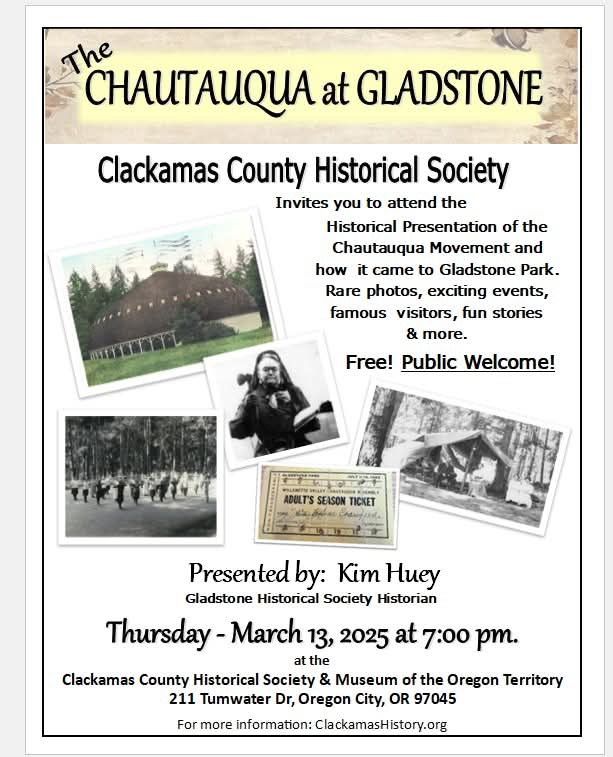
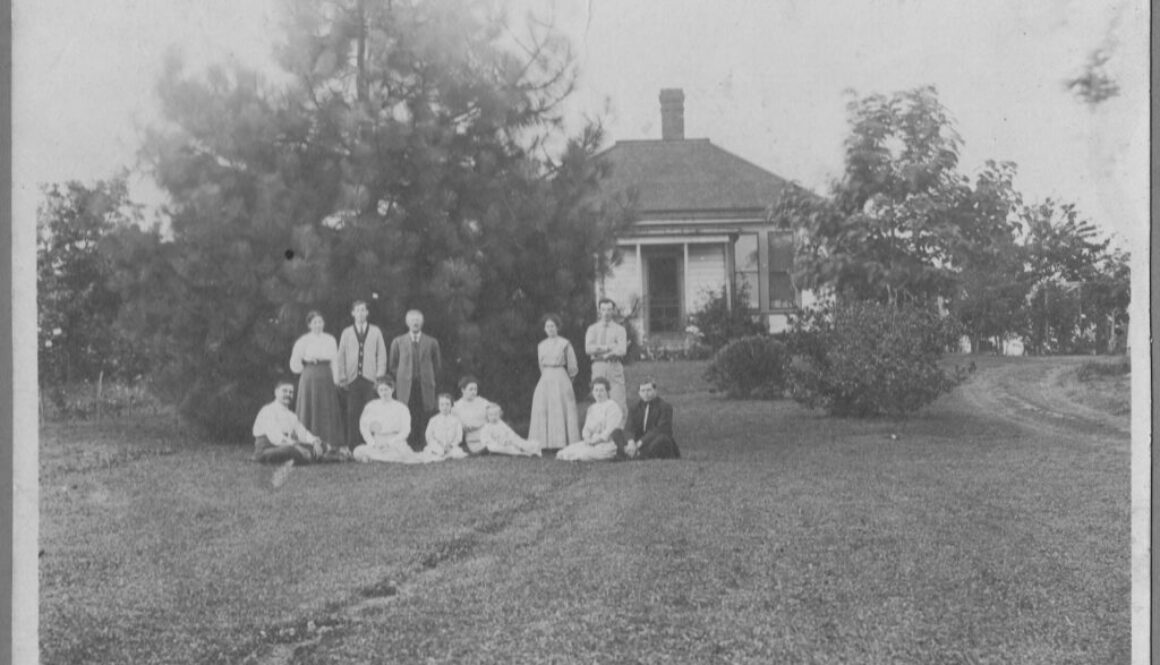
The Thiessen Family
Most folks in Oak Lodge are familiar with Thiessen Road. The road was named after the Henry Thiessen family whose farm was located at the crest of today’s Thiessen Rd., at Wallace Rd.
Henry (Heinrich) Thiessen was born in Tellingstedt, Schleswig-Holstein near Heide – then part of Prussia. There is some confusion as to his exact birth date. Some sources say he was born in 1848, others say 1851, 1852 and 1853. The most likely seems to be Oct. 23, 1851. He was the son of Heinrich Christian Thiessen and Dorothea Frahm. His mother died when Henry was three, and his father passed when Henry was ten. When he was young Henry was taught in both Danish and German.
According to Chapman (Portland & Vicinity, Chapman Publishing Co. 1903) Henry and a sister immigrated to the U.S. when Henry was 12. They first settled in Davenport, Iowa where Henry found employment on a farm for a year and a half. In 1867 he removed to Nebraska, settling at Grand Island in Hall County where he farmed and attended school. He was enumerated there in the 1870 census, age 19. Again, according to Chapman, “He was the first to teach school in Hall County”. It was while living in Hall County that Thiessen applied to become a U.S. citizen.
About 1870 Thiessen left Nebraska and traveled west to California, eventually settling in San Jose where he found work on the J.H. Ogier farm. It was here that he met Selena (Lena) Derry, whom he married on Sept. 14, 1875. Selena was the daughter of Thomas and Patience (Matthews) Derry.
In the spring of 1880 Henry and Selena, along with their children Dorothea and Henry Thiessen, left San Jose and traveled to Portland, OR by stagecoach, and it was in Portland where the family was enumerated on June 21, 1880. In Portland Henry first worked at a brewery, then as a foreman for William S. Ladd on Ladd’s “Hazelfern Farm” at Laurelhurst, as well as “Crystal Springs Farm” near present day Reed College.
From the Clackamas Co. deed dated Oct. 3, 1879 Henry Thiessen purchased 180 acres on the Jason Kellogg Donation Land Claim, adjacent to the Michael Oatfield farm, from Pilgrim Neal. It was here that Thiessen established his farm. (The Thiessen’s first two children were born in San Jose, Dorothea in June 1876 and Henry in Nov. 1879, a month after the deed. So, Thiessen may have traveled to Portland alone to locate property prior to the family moving to Portland). On today’s maps Thiessen’s farmhouse was at the crest of Oatfield ridge, at Wallace Rd., on the southeast side of Thiessen Rd. From Thiessen’s diary: “Bought farm in Clackamas County, about 130 acres (sic) of the Jason Kellogg Donation Land Claim – Section 7, Township 2 South, Range 2 East. Moved to Milwaukie house on Risley property on Oatfield Road (near present day Risley Ave.) to work on new farm. Clearing of land, building house and barn, planting garden and crops required hard labor and long hours for all the family. Much of the acreage was heavy timber.” From Chapman – “All of which was unimproved and development of which involved an immense amount of labor.”
At various times Thiessen called his farm “Huckleberry Farm”, “Mountain View Farm”, and “Sightly Farm”. But it was “Sightly Farm”, named from the commanding view of Mt. Hood, that stuck. It consisted primarily of general farming, and stock raising. Fruit and potatoes were two marketable crops. By 1915 Henry Thiessen and sons Wesley and Lee had developed a large purebred Jersey herd. Wesley had attended Oregon Agricultural College and Lee studied Dairy Farming and Agriculture at OAC for several terms. Henry A. was in business at Oregon Grain Co. and helped with feed buying. For a time, Henry Sr. served as president of the Oregon Jersey Cattle Producers Association.
Henry & Selena had six children: Dorothea (Dora b. 1876), Henry Albert (b. 1879), Minerva (b. 1882), Annie May (b. 1885), George Wesley (b. 1888), and Raymond Lee (b. 1896). The Thiessens and Oatfields, being neighbors, were very close and interacted a great deal. In fact, in 1903, Dora married Phil Oatfield and they moved into Phil’s new house on Oatfield Rd. near today’s Risley Ave. The two families often picnicked and fished together, and early county documents are rife with their names. Entries from Henry Thiessen’s diary also reflect interaction with other early families in the area, including the Starkweathers and Risleys. Each of the other Thiessen children married – Henry A. to Mildred Gower, Minerva to Capt. Edmund M.J. Herre’, Annie May first to Albert LaPore and then Daniel McLean, and Raymond Lee to Evelyn Potter. George Wesley Thiessen first married Emma Phillips, and later Edna Brown. George Wesley Thiessen was very active in the community and became a Justice of the Peace for a number of years. Unfortunately he had to resign due to health issues. His wife, Edna Brown Thiessen, was then appointed by Governor Snell to fill the vacancy. She was a Clackamas County judge for thirteen years, having been elected twice for 6 year terms, and served until her retirement in 1960. Henry Albert Thiessen also became a judge, in Gilliam Co., Oregon.
The Thiessen family home at Thiessen & Wallace Rds. survived over 140 years, but was never nominated to become a Clackamas County’s Historic Landmark. It was ultimately demolished in 2024.
Selena Thiessen died in 1929, and Henry in 1935. Both were buried at Riverview Cemetery in Portland.
Sources: Thiessen and Derry family histories and documents provided by Inez Oatfield West and Irene Oatfield Laudien.
The Naef Family
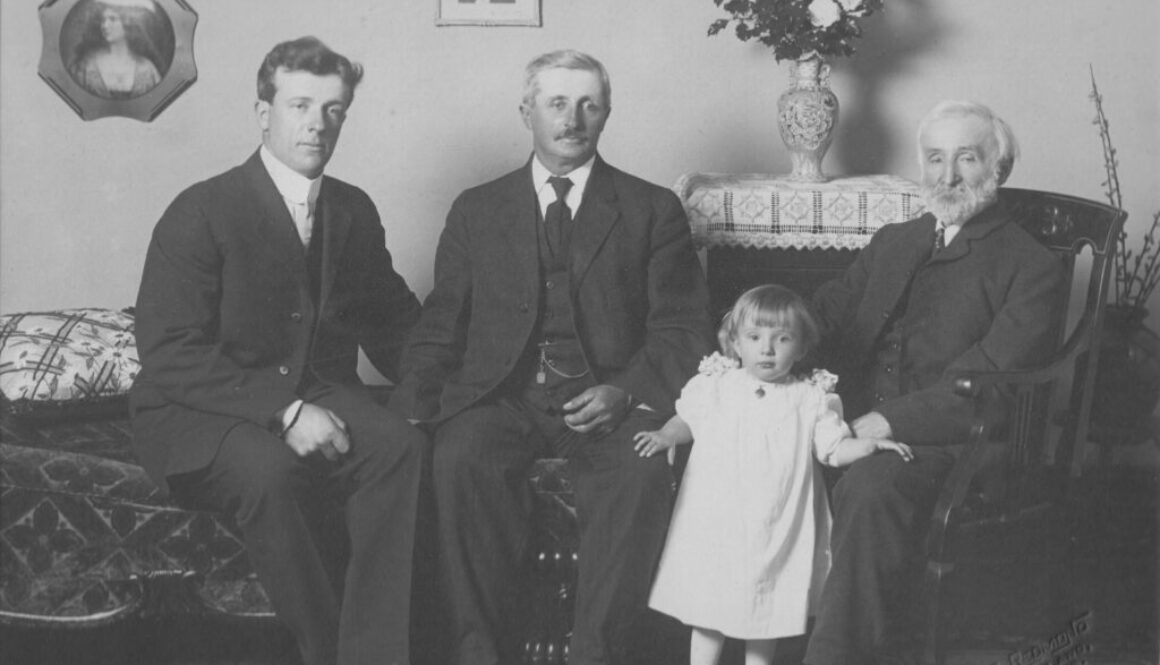
John Jacob “Hans” Naef (pronounced ‘Neff”) was born in Zurich, Switzerland in 1837. He and his wife were farmers in that area. Their son, Otto Naef (Sr) was born in Zurich June 9, 1859. While still in Switzerland Otto married Mary Susanna Wyder in 1881. John Jacob Naef’s wife died in Switzerland prior to 1887.
In early 1887 John Jacob Naef and Otto (Sr.) emigrated to the United States. They originally intended on settling at Helvetia in Washington County, but they instead chose to settle in the Oak Grove area. Leaving John J. Naef in Oregon Otto returned to Switzerland and brought back his wife Susanna and sons Otto (b.1882) & Ernest (b.1887), arriving in NY on Aug. 15, 1887 aboard the steamship Bretagne. Also on board the Bretagne was the Rudolph Staub family, also from Zurich. Traveling by train they reunited with John Jacob Naef in Oak Grove to begin farming.
On Sept. 19, 1887 Rudolph Staub, the Naef’s traveling companion, purchased 220 acres in the Oak Grove area from William A. & Eliza Starkweather which the Starkweathers had purchased in 1865. The following November, Nov.5,1887, the Staubs deeded 100 acres of the Starkweather property to John J. Naef. (On Aug. 1, 1889 the Staubs deeded their remaining 120 acres to John G. Roethe. Staub had been a pastor in Switzerland, and following his selling his property in Oak Grove Rev. Staub removed to Beaver Creek in Clackamas Co. to become the pastor of the Congregational Church there, and later to New Era). Both John J. and Otto Naef filed their Declaration of Intent (to become citizens) in Oregon City in 1888.
The Naef’s 100 acres stretched from the Willamette River east to today’s Harold Ave., and from just north of today’s Naef Rd. south halfway to today’s Roethe Rd. The family home was constructed a hundred yards west of today’s McLoughlin Blvd., on the north side of today’s Naef Rd. – adjacent to a spring fed creek that originated on the east side of today’s Harold Ave. This creek provided the necessary water for their homeplace and livestock. The family started a dairy, later called Oak Knoll Dairy, on the property east of River Rd. That part west of River Rd. was too steep and forested for farming.
John J. Naef granted Eastside Railway Co. a 40 ft. right-of-way across his farm in 1893, giving the family access north and south to Portland and Oregon City – and Naef Station was established.
In 1892 a dispute erupted between John J. Naef, and his neighbor to the south, John G. Roethe, over the ownership of a manure pile located on the shared property line. Both claimed ownership based on their perceptions of the location of the boundary line between them, and manure was important to their farming. A court case eventually ensued, and the line was ultimately agreed upon by an exchange of deeds between Otto Naef and John G. and Alweine Roethe on Oct. 17, 1907.
In 1896, at the age of 59, John J. Naef deeded his son Otto his entire farm, with the exception of the railway line, River Rd., and 5 acres sold to A. Franklin in 1893. Otto operated much of the farm as a dairy which went by the name “Oak Knoll Dairy”.
In Nov. 1910 Otto Naef sold the 17 acres west of River Rd. – of little use for farming – to a wealthy Portland business tycoon named Theodore Kruse. Two years later, in 1912, Kruse lost the property to his wife, Marie E. Daggett Kruse, in a divorce proceeding.
In 1918 John J. Naef died. Otto was by then a widower – his wife Susanna having died in Nov. 1910. Otto and his two sons, Otto H. Naef and Ernest, continued operating “Oak Knoll Dairy” until 1919. Citing increased development and higher taxes “O. Naef & Sons” auctioned off their cows and ceased operation of the dairy. In early 1923 Otto deeded his son Ernest and his wife Ruth a lot on River Rd. on the N.E. corner of River Rd. and Naef Rd., upon which they built their home. When Otto died in late 1924 the remaining farm was split in two – the north half on the north side of Naef Rd. to Ernest Naef, and the south half on the south side of Naef Rd. to Otto’s daughter-in-law Rosa (Rose) E. Naef who had been left a widow when Otto Sr.s other son, Otto Henry Naef, had died in 1920 from the flu epidemic. Rosa leased her half of the farm to dairy operators such as the Crystal Springs Dairy and Huddle & Stoll and their “Superior Dairy”, and lived in the house she and Otto H. Naef had built on the S.E. corner or River Rd. and Naef Rd.
Following the sale of the dairy cows and Otto’s death Ernest farmed his share of the farm. In 1925 Ernest and his wife Ruth sold the east half of their property, east of the railway, consisting of 29.81 acres to Eldon J. and May Steele who operated it as Steele’s Pansy Gardens into the mid-1940’s. The Steele’s eventually moved into the Naef’s original 1890’s family home and irrigated their pansy fields from the original Naef well. Steele’s pansies were world renowned and Ernest served as the superintendent of the Pansy Farm for many years. When the Super 99 highway was completed in 1936 it cut the property in two, creating hardships for the Steeles and the dairy operators.
As the years progressed the Naefs sold off much of their holdings. In 1946 Ernest & Ruth Naef, and the children of Rosa Naef, sold some acreage on the south side of Naef Rd. to Theodore & Mildred Stringfield – – – acreage that later became the Stringfield Family Park. Rosa’s share of the farm east of McLoughlin Blvd. eventually became the “Super 99 Drive In”. Her property west of McLoughlin but east of the railway was operated at one time as Crystal Springs Dairy, and was later leased to dairymen “Huddle & Stoll” (Kenneth Huddle & Ray Stoll) in 1940. Huddle & Stoll purchased Rosa’s property from the railway to McLoughlin Blvd. in 1947, and operated “Superior Dairy” until 1957. Rosa sold off her remaining lots in the 1950’s but continued living in her house on River Rd. until her death in 1962.
A few descendants of the Naef family still live in Oak Grove, and have kindly provided the community with the family history, and loaned many of their family photos to be shared.
OLHD Update
Though our OLHD meetings are still on hold, we wanted to let folks know what we’ve been up to lately:
Concord Historic Marker: A March meeting has been scheduled with NCPRD to discuss installing a historical marker commemorating the two original school buildings on the Concord Complex site – in 1890 and 1910. We have offered to help pay for the markers, and/or instigate a fundraiser. Donations are welcome.
The Bomber program: A date of May 30 has been set for a joint program between OLHD and the B-17 Alliance Foundation about the Bomber – to be given at Rose Villa. A flyer will be forthcoming.
Oak Grove Festival: OLHD is registered to have three spaces at the Festival on June 28th – – more than likely at the same location as last year. Our theme this year will be “Gone But Not Forgotten” – businesses and historic buildings that we’ve lost.
Oak Lodge Library History Room: The new Oak Lodge Library, at Concord, is slated to open in August, with a Grand Opening Celebration tentatively slated for Oct. 18th. OLHD is working with the library to plan what materials will be placed in the room, rules of use, and arranging for volunteers to staff it.
OLHD Website: The new OLHD website continues to get improvements made, bugs fixed, and additional history added. It is, and will be, a “work in progress”. 64 archives are now included, the Timeline has been built, and 23 historic sites have been added to the interactive Land Claims map. Hovering over the marker on the map will identify the purpose of the marker, and clicking on it will display an image from our archives. Details for the McLoughlin Blvd. businesses map are still being developed. We finally have working DONATIONS and CONTACT buttons on the website. We will be starting to actively promote the new website very soon. This new website is intended to supplement the new library’s history holdings and serve as a major source for knowledge about Oak Lodge’s history.
Publicity: A “save the date” notice for the Oak Grove Festival has been placed on both the website and OLHD Facebook page. Additional notices will soon be going out for the Bomber program, the new library History Room, promotion of the website, and information about the Concord historical marker as details are firmed up.
Local History Donations: OLHD is always interested in donations of photos and documents pertaining to Oak Lodge History that we can add to our archives. In the event that the donor does not want to part with their item OLHD can scan it and return the original.
Should you have any questions, contact us via the “Contact” button on this website.
Mike Schmeer
President, Oak Lodge History Detectives
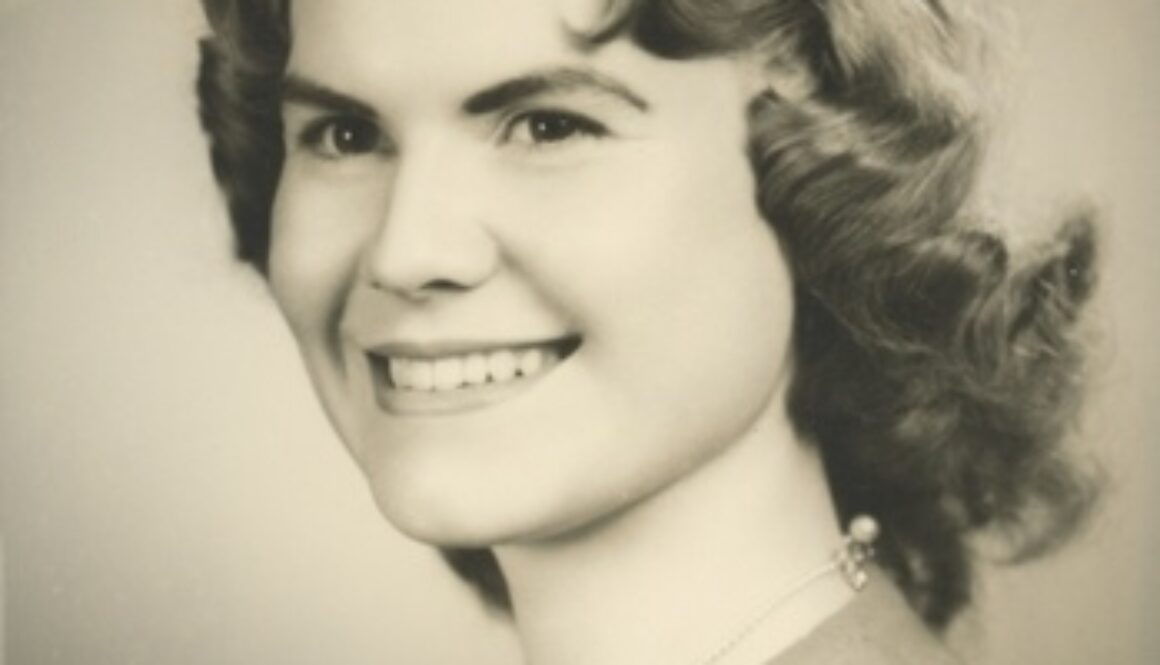
In Memory of Mary Piper
John G. Roethe
John Roethe
(Jan. 2025)
John (Johann) Gottlieb Roethe (pronounced Row-thee) was born Jan. 25, 1842 in Prussia. His parents were Johann Gottlieb Roethe and Johanne Elisabeth Schrodter, both who died in Prussia. While in Prussia John served as a volunteer in the cavalry service of the Prussian army for 2 ½ years, and served in the war between Prussia and Austria in 1866. In 1869 John Roethe boarded the ship S.S. Union in Bremen, Germany and sailed to America.
He arrived in NY on May 8, 1869, along with a Kirchhoff family of eleven, one being Wilhelmina Kirchhoff. Roethe first settled in St. Clair Co., Illinois for six months, then moved to Humboldt Co., Iowa where he bought a farm of 150 acres. He then moved to Webster Co., Iowa and bought a farm of 320 acres. According to a Jan. 1908 Clackamas Co. “Official Register of Electors” it was in Iowa where Roethe naturalized to become a U.S. Citizen. And it was in Webster Co., Iowa where he married his shipmate, Wilhelmina Kirchhoff (also spelled Kirchhof) on April 23, 1870, and from this union they had three children – Edward Ernest, Hedwig, and Otto Paul Roethe. Sadly, Wilhelmina died in Webster County in 1876, leaving John Rothe a widower with three children. In 1876, still in Webster Co., John remarried, to Anna Scheriff where the family was enumerated in the 1880 census. Unfortunately Anna also died, in 1881, while still in Webster Co.. Again John married, in Feb. 1882, to Christine Alwiene Kunnert (a.k.a. “Alvina Kunert) in Colfax Twp., Webster Co., Iowa. From this union there came two daughters, Emma and Lena Roethe – Emma possibly having been from a former marriage of Alvina’s.
In 1888 John Roethe moved his family to Oregon, first briefly renting land in Bethany in Washington County, but in 1889 he purchased 120 acres from Rudolph & Anna Staub in Clackamas County and commenced farming it. Staub’s land had originally been part of William Starkweather’s 220 acres which he had acquired in Sept. 1887 but had sold 100 acres of it to John J. Naef the following November 1887. John Roethe’s 120-acre farm stretched from the Willamette River east to today’s Harold Ave., and from halfway between today’s Naef and Roethe Roads south nearly to today’s Ina Ave. In those early days there was a river boat landing at the foot of today’s Hillside Drive where farmers would load their harvest onto a sternwheeler to be taken to Portland or Oregon City. The landing had originally been called “Starkweather Landing”, as the property had belonged to William Starkweather. Later on the Roethes renamed it the “Roethe Bros. Landing” and it was used for fishing, pleasure boating, floating lockers and a gathering place for people. In 1893 Roethe granted a 40 foot wide easement to the East Side Railway Company for a “double track motor railway”. Speaking years later about the part of their farm on the upper, level ground the Roethes commented that there must have been a school on their property, as they had plowed up much broken glass and slates (the “Riverside School”, 1866-1890).
In 1900 John & Alwiene Roethe purchased another 8.23 acres along the Willamette River immediately south and adjacent to their farm property. This property had been part of the 47 acre Henry Naas property, whose estate was administered by Charles Risley after Naas’ death in 1889. John and Alwiene subsequently deeded this 8.23 acres to their son, Edward Ernest Roethe, in 1904.
Though neighbors, the relationship between the Roethes and the Naefs was not always harmonious. In 1892 a dispute erupted between John G. Roethe, and his neighbor to the north, John J. Naef, over the ownership of a manure pile (an important resource for farmers) located on their shared property line. Both claimed ownership based on their perceptions of the location of the boundary line between them, and manure was important to their farming. A court case eventually ensued, and the line was ultimately agreed upon by an exchange of deeds between Otto Naef and John G. and Alwiene Roethe on Oct. 17, 1907.
That same month and year, Oct. 1907, John Roethe sold the easternmost 104 acres of his farm to Simeon H. Covell and David N. Smith. It consisted of that portion of Roethe’s land east of today’s River Rd. (the “Rinearson & Milwaukie Rd.”) to today’s Harold Ave. The following year Covell and Smith platted that property as “Covell”. Roethe retained his remaining 16 acres of the original farm, from today’s River Rd. to the Willamette River.
In 1909 John & Alwiene platted some of the remaining 16 acres of their farm as “Roethe’s Willamette River Front Lots”, much of which became that of their son, Edward Ernest Roethe, who continued farming the upper, level portions nearer River Rd. In later years Roethe descendants developed the property near the river into a rental business of summer cottages, with garages at the top of the hill.
In the 1910 census John G. and Alwiene Roethe were still living in Oak Grove., but by 1920, due to failing health, they had removed to Lodi, California to be near their daughters Hedwig Klostermann and Lena Kirchhof. John died in Lodi on May 4, 1921. Alwiene continued living there until her death on May 13, 1938.
Roethe descendants continued living near Rothe Station and the surrounding area well after John and Alwiene departed to California – and still do. Today the Roethe legacy continues through those descendants, a road named for the family, a trolley station referenced in hundreds of old real estate ads, and the names of several subdivisions.
Credits: Roethe family gathering May 4, 2011; John & Linda Roethe interview May 16, 2011; Roethe family tree of Thelma (“T.J.”) Roethe; Portrait and Biographical Record of the Willamette Valley, by Chapman Publishing Co. 1903, John G. Roethe, p.378; Clackamas County Deeds; Clackamas County Surveyor Information System (CCSIS); Ancestry.com; FamilySearch; Roethe family photos; Roethe property abstract of title; The Gretchen Roethe Property by Lisa Bentley, researched by Michael G. Schmeer and John & Linda Roethe 2014;
Philip T. Oatfield
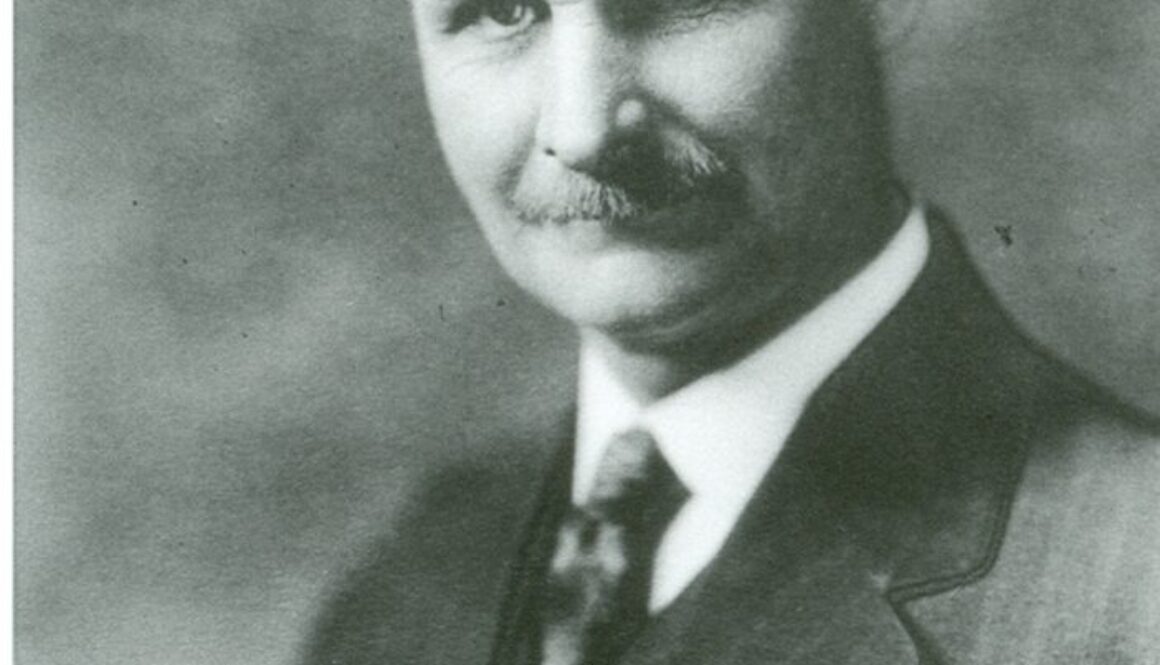
Philip Thessing Oatfield was the third child born to Michael & Minerva (Thessing) Oatfield. Born on Oct. 11, 1873, he was born on Michael Oatfield’s 600+ acre farm on today’s Oatfield Rd. in Milwaukie – in a farmhouse a few hundred feet south of today’s Concord Rd. In his early years he worked around the family farm doing general farming chores, planting, harvesting, gardening, and picking fruit. He occasionally rode into Portland for supplies (taking one day, round trip), attended to the farm horses, and hauled sacks of wheat to New Era and potatoes to Risley Landing – both by wagon. Along with his brothers “Will” and John, Phil attended the “Riverside School” on River Rd. near Roethe’s Landing, followed by Concord Grammar School beginning in 1890 and the newer Concord School built in 1910. Afterwards he attended the Holmes Business College at 10th & Washington in Portland (as did his brother John) for one year. In those early days families were few, and spread out. The Oatfield’s nearest neighbors were the Thiessens, headed by Henry & Selena (Derry) Thiessen whose home was at today’s Thiessen and Wallace Rds. Thiessen, originally from Denmark, had purchased 180 acres in 1879 and raised six children there.
In 1903 Michael Oatfield, then having reached the age of 68, divided his farm among his six children, reserving a small parcel for him and Minerva. Phil Oatfield received 100 acres, the deed being dated Feb. 12, 1903. Phil’s portion was basically between today’s Hill Rd. and View Acres Rd., and from Oatfield Rd. to the crest of Oatfield hill. It is most likely no coincidence that that same year, on Nov. 8, 1903, Phil married Henry Thiessen’s oldest daughter, Dorothea (Dora) S. Thiessen and they moved into the house he had built on Oatfield Rd. at today’s Risley Ave. Together they had two daughters, Anne Inez Oatfield and Irene Elsie Oatfield, in 1904 and 1908 respectively. The family remained in that house until 1922 when Phil built a new home a little further north nearer today’s Hager Lane – but still on his original 100 acres.
Despite having served repeatedly as a director for First State Bank in Milwaukie for many years (ca. 1913-1941), and at times as Vice President, Phil always considered himself a farmer. He and his older brother John R. Oatfield farmed John’s share of their father’s farm as the “Oatfield Brothers” for many years. The two Oatfield brothers’ names appear on many early Clackamas County road documents and deeds, and both served their community in several ways.
Phil and Dora Oatfield continued living in their 1922 home on Oatfield Rd. into their old age, gradually selling off parcels from Phil’s original 100 acres, but reserving three acres for themselves. Dora Oatfield died in 1935 but Phil continued living there until his death in 1950. His home place was subsequently purchased by Roy C. Schmeer. The Oatfields were a well-respected family in the community and left behind a lasting legacy.
Credits: Irene Oatfield Laudien, Inez Oatfield West, Gloria Laudien Stone – Oatfield family history, photos and documents, U of O Historic Oregon Newspapers website, As We Remember It by Tom Humphrey 1959 pp. 22-25